How Traction Control Calibration Defines a Car’s Character
When drivers think about a vehicle’s personality, they usually point to the exhaust note, the weight of the steering wheel, or how hard the engine pulls toward the redline. Yet, in the modern automotive landscape, an invisible layer of software plays a massive role in shaping how a car feels on the road. Traction control, once a primitive safety feature designed solely to prevent winter weather mishaps, has evolved into a sophisticated tool for brand identity and dynamics tuning.
The calibration of a vehicle’s traction control system (TCS) serves as the ultimate digital translator between mechanical capability and driver experience. By altering a few lines of code, engineers can transform a vehicle from a cautious, safety-first commuter into a sharp, tail-happy track weapon. Understanding this calibration reveals just how much a car’s soul relies on its digital architecture.
The Core Mechanics of Traction Control
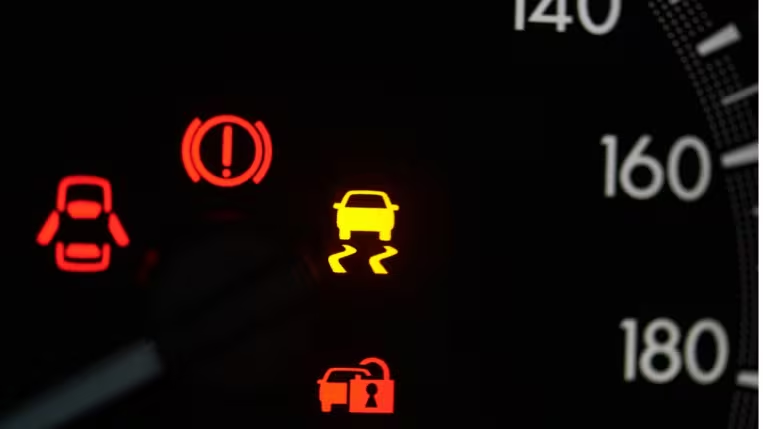
To understand how calibration shapes a car’s character, it is essential to look at what the system does behind the scenes. At its foundation, traction control monitors the rotational speed of all four wheels using ABS sensors. When the system detects that a driven wheel is spinning faster than the non-driven wheels, indicating a loss of grip, it intervenes to restore stability.
Engineers have several tools at their disposal to manage this wheel slip:
-
Brake Application: The system can independently apply the brake to the spinning wheel, forcing torque across the differential to the wheel with more grip.
-
Throttle Management: The electronic throttle body can close slightly, reducing engine power regardless of how hard the driver presses the accelerator pedal.
-
Ignition Retardation or Fuel Cutoff: For instantaneous power reduction, the engine control unit (ECU) can delay spark timing or cut fuel to specific cylinders, dropping torque in milliseconds.
The magic, however, lies not in the hardware, but in the calibration. Calibration is the art of deciding when the system intervenes, how aggressively it cuts power or applies brakes, and how quickly it hands control back to the driver. This tuning process dictates whether a car feels restrictive, seamless, or exhilarating.
The Safety Paradigm: The Invisible Safety Net
For standard commuters, family SUVs, and economy sedans, traction control calibration prioritizes predictability, stability, and safety above all else. The goal of this tuning philosophy is to eliminate drama before the driver even realizes a low-grip situation has occurred.
In these vehicles, the slip threshold—the amount of wheel spin allowed before the computer steps in—is set incredibly low. If a front-wheel-drive sedan hits a patch of wet leaves, the system reacts almost instantly. The throttle closes, brakes clamp down on the spinning wheel, and the car maintains its trajectory.
The character resulting from this calibration is one of absolute competence, though it can feel frustrating to enthusiast drivers. Under heavy acceleration out of a corner, the car may seem to “bog down” or refuse to accelerate. This is the calibration intentionally withholding power to ensure the tires never break loose. It treats wheel slip as an error to be corrected immediately, reinforcing a character of safe, unyielding stability.
Sports Cars and the Illusion of Analog Freedom
When moving into the performance realm, the calibration philosophy changes entirely. Sports car manufacturers understand that a complete lack of wheel slip makes a performance vehicle feel clinical and unexciting. Drivers want to feel the chassis move, hear a slight chirp from the tires, and manipulate the car’s balance using the throttle.
Performance traction control calibration utilizes higher slip thresholds and sophisticated algorithms that predict driver intent. Instead of cutting power completely, a sports car’s TCS might allow 10% to 15% wheel slip. This permits the rear of a rear-wheel-drive sports car to step out slightly in a corner, giving the driver the thrill of a slide while the computer maintains a quiet safety net in the background.
Furthermore, performance calibrations are designed to be smooth. Instead of a jarring drop in engine power, the system might subtly retard ignition timing, trimming just enough torque to keep the car balanced without disrupting the weight transfer. This creates an illusion of pure mechanical grip, making the driver feel highly skilled rather than managed by electronics.
Track Modes and Dynamic Slip Control
Many modern performance vehicles feature multi-stage traction control systems, often accessed via track modes or dedicated dials on the steering wheel. These systems showcase the true power of calibration, allowing a single vehicle to exhibit multiple distinct personalities.
A prime example is found in modern supercar track modes, which often feature variable traction control. Rather than a simple on-or-off switch, these systems give the driver precise control over the permitted slip angle.
-
Mode 1 (Wet/Comfort): High intervention, zero tolerance for slides.
-
Mode 2 (Sport): Moderate slip allowed, allows for mild oversteer but intervenes if the angle becomes too wide.
-
Mode 3 (Track/Race): Designed for maximum lap times. The system allows the tires to operate at their optimal slip ratio for peak acceleration, only intervening if the car is completely out of control.
By changing these settings, the car’s character shifts from a locked-down highway cruiser to a fluid, aggressive track machine. The hardware remains identical, but the digital boundaries change.
The Challenge of All-Wheel Drive and Off-Road Calibration
Traction control calibration is equally vital in defining the character of off-road and all-wheel-drive (AWD) vehicles. In an off-road setting, wheel spin is not always an enemy. When digging through deep mud, sand, or snow, a vehicle often needs continuous wheel spin to clear the tire treads and maintain momentum.
An off-road traction control calibration, therefore, behaves inversely to a street safety system. When a rugged SUV is placed in a “Mud and Ruts” mode, the calibration allows significant wheel spin while aggressively using the brakes to mimic locking differentials. If one wheel lifts off the ground, the system quickly clamps the brake on that airborne wheel, forcing engine torque to the opposite side that still has contact with the earth.
This calibration creates a rugged, unstoppable character. The vehicle feels mechanical, gritty, and capable of clawing its way through extreme terrain, driven entirely by how the software manages brake pressures and engine torque in low-traction environments.
Electric Vehicles: The New Frontier of Calibration
The transition to electric vehicles (EVs) has opened a whole new dimension for traction control calibration. Internal combustion engines have an inherent delay between the driver pressing the pedal and the engine delivering torque to the wheels. Electric motors, however, deliver maximum torque instantly, from zero RPM.
This instant torque presents a massive challenge and an incredible opportunity for calibration engineers. Traditional traction control systems look at wheel slip every few milliseconds. Advanced EV traction control loops operate up to ten times faster, reacting in fractions of a millisecond.
Because the electric motor itself can act as the sensor and the regulator, the traction control can adjust torque output directly at the motor level. This creates a character of surreal, effortless grip. An EV can accelerate hard on a split-surface road (one side on ice, one side on dry asphalt) without a single shudder, pull, or drop in momentum. The calibration creates a character that feels almost supernatural, defying the expected laws of physics.
Frequently Asked Questions
Does turning off traction control completely disable all safety systems?
In most modern vehicles, pressing the traction control button only disables the wheel-spin regulation, allowing the tires to spin freely. It usually does not fully deactivate Electronic Stability Control (ESC), which monitors the car’s overall directional stability and applies individual brakes to prevent a spin or skid. Completely disabling ESC often requires holding the button down for several seconds or entering a hidden diagnostic menu.
Why does my car struggle to pull out of a snow-covered driveway with traction control on?
When a car is stuck in deep snow, the tires need to spin to fling the snow out of the tread and find traction underneath. Because standard traction control calibrations detect this wheel spin as a loss of control, the system will cut engine power and apply the brakes, often leaving the vehicle completely stationary. Turning the system off temporarily is usually recommended to break free from deep snow or mud.
Can aftermarket tuning change how my traction control behaves?
Yes, aftermarket software tunes can alter the calibration parameters of the factory traction control system. Tuners can adjust the slip thresholds, reduce the severity of power cutbacks, or reprogram throttle response during slip events. This is highly popular among track enthusiasts who want a more permissive factory system without disabling it entirely.
How does traction control calibration affect tire wear?
A highly restrictive traction control calibration generally preserves tire life by preventing prolonged wheel spin and burnout scenarios. Conversely, performance or track calibrations that allow a higher percentage of slip or controlled drift angles will increase tire wear, as the rubber is subjected to greater friction and heat generation during aggressive driving.
What is the difference between traction control and torque vectoring?
Traction control is a reactive safety and stability system designed to reduce power or apply braking when a wheel loses grip. Torque vectoring is a proactive performance system that actively distributes power between the left and right wheels during cornering to improve agility and reduce understeer, often speeding up the outside wheel to help rotate the car into a turn.
Why do some sports cars feature a launch control mode?
Launch control is a specialized traction control calibration designed for maximum acceleration from a complete stop. Instead of simply cutting power when the wheels spin, launch control modulates engine torque perfectly at the absolute limit of tire adhesion, maintaining the ideal amount of slip required to launch the vehicle as quickly as possible.